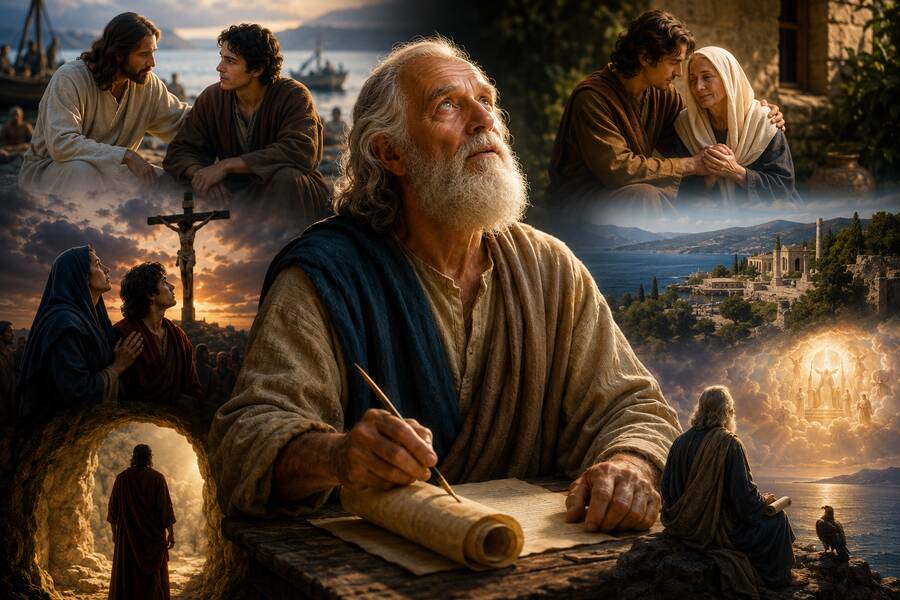
Saints PH | Saint John the Apostle: The Last Witness of Christ, Guardian of the Blessed Virgin Mary, and the Apostle of Love
Among all the Apostles of Jesus Christ, perhaps no figure remains as mysterious, beloved, and spiritually captivating as John the Apostle. He was the disciple closest to Jesus, the guardian of the Blessed Virgin Mary, the author traditionally associated with the Gospel of John and the Book of Revelation, and according to Christian tradition, the last surviving Apostle who personally walked with Christ.
John’s story stretches across some of the most important moments in Christian history. He witnessed miracles performed by Jesus in ancient Galilee, stood at the foot of the Cross in Jerusalem, cared for the Blessed Virgin Mary after the Crucifixion, survived persecution under the Roman Empire, experienced the visions recorded in Revelation while exiled on the Greek island of Patmos, and eventually spent his final years guiding the early Church in Ephesus, located in present-day Turkey.
His life was not simply extraordinary because he lived long. It was extraordinary because he remained faithful through every stage of suffering, transformation, uncertainty, persecution, and spiritual revelation.
John was originally a young fisherman from the region surrounding the Sea of Galilee in what is now northern Israel. He was the son of Zebedee and Salome and worked alongside his brother, James the Great. Before meeting Jesus, the brothers likely lived a relatively ordinary life focused on fishing, family responsibilities, and survival under Roman occupation.
Everything changed when Jesus called them.
According to the Gospels, John and James were repairing fishing nets with their father when Christ invited them to follow Him. Without hesitation, they left their boats and began the journey that would forever change human history.
At the time, many Christian traditions believe John may have been one of the youngest Apostles, perhaps even a teenager. Yet despite his youth, he quickly became one of the disciples closest to Jesus.
John’s personality in the beginning was not always gentle or peaceful. In fact, he and James were once nicknamed “Boanerges,” meaning “Sons of Thunder.” The name reflected their fiery temperament. On one occasion recorded in Scripture, the brothers became angry after a Samaritan village refused to welcome Jesus. They asked Christ whether they should call down fire from heaven upon the village.
This dramatic moment reveals something deeply human about John. He was passionate, emotional, impulsive, and intense. Yet over time, this same young man would undergo one of the greatest spiritual transformations in Christian history. The once fiery “Son of Thunder” would eventually become known as the Apostle of Love.
As Jesus continued His ministry throughout regions now part of Israel and Palestine, John became part of Christ’s innermost circle together with Peter and James. These three disciples witnessed sacred moments hidden from the others.
John personally witnessed the raising of Jairus’ daughter from the dead. He stood upon Mount Tabor, believed to be in present-day Israel, during the Transfiguration when Jesus’ divine glory was revealed before them. He also accompanied Christ into the Garden of Gethsemane, located at the foot of the Mount of Olives in Jerusalem, during the agonizing hours before His arrest.
These experiences deeply shaped John’s understanding of Jesus not merely as a prophet or teacher, but as the Son of God Himself.
Among the Apostles, John’s relationship with Jesus appeared uniquely close. The Gospel repeatedly refers to him as “the disciple whom Jesus loved.” During the Last Supper in Jerusalem, John reclined beside Christ and rested near His chest as Jesus spoke about betrayal and suffering.
But perhaps the most important and emotional moment in John’s life occurred during the Crucifixion.
As Jesus was condemned to death and nailed upon the Cross at Calvary in Jerusalem, most of the disciples fled in fear. Roman execution was brutal, public, and terrifying. Associating with a condemned man could place others in danger as well.
Yet John stayed.
Standing beside him was the Blessed Virgin Mary.
Imagine the scene. Darkness covered the land. Roman soldiers surrounded the area. The crowds mocked Jesus. The Apostles were scattered and afraid. Yet there stood John beside Mary, remaining faithful during the darkest moment of Christ’s earthly suffering.
Then came one of the most profound moments in all Christian tradition.
Looking down from the Cross, Jesus said to His mother:
“Woman, behold your son.”
Then to John He said:
“Behold your mother.” — John 19:26–27
From that moment onward, Christian tradition teaches that John took Mary into his home and cared for her as his own mother.
For Catholics, this event carries immense spiritual meaning. John symbolically represented all faithful Christians entrusted to the maternal care of Mary.
But beyond theology, the moment also reveals something deeply personal about John’s character. Jesus entrusted His own mother to him. That trust alone speaks volumes about the bond between Christ and John.
After the Resurrection and Ascension of Jesus, John remained deeply connected to the Blessed Virgin Mary during the earliest years of Christianity. Ancient Christian traditions suggest they stayed for some time in Jerusalem, where Mary became a source of strength, prayer, and encouragement for the growing Christian community.
The Apostles at that time faced enormous uncertainty. Christianity was still small, persecuted, and vulnerable. Roman authorities viewed Christians with suspicion, while many religious leaders opposed them. Amid this instability, Mary’s presence likely brought comfort and spiritual guidance.
As persecution intensified in the region, longstanding Christian tradition says John eventually brought Mary to Ephesus for safety. Ephesus was then a major city of the Roman Empire located near the western coast of modern-day Turkey.
Today, pilgrims from around the world visit a site near Ephesus known as the House of the Virgin Mary. While historians debate certain details, many Christians believe Mary spent her final earthly years there under John’s care.
This aspect of John’s life is especially moving because it reveals decades of hidden faithfulness rarely emphasized compared to his dramatic visions in Revelation. John was not merely preaching publicly or performing miracles. He was also quietly honoring Christ’s final request by caring for Mary with devotion and love.
John also became one of the earliest witnesses to the Resurrection itself.
When Mary Magdalene informed the disciples that Jesus’ tomb was empty, Peter and John ran together through Jerusalem toward the burial site. According to Scripture, John arrived first but respectfully allowed Peter to enter ahead of him.
Inside the tomb, John saw the burial cloths and believed.
This experience transformed him forever.
John no longer followed Jesus merely out of admiration. He now preached with certainty that Christ had conquered death itself.
This conviction would sustain him through decades of persecution and hardship.
As Christianity spread throughout the Roman Empire, John emerged as one of the central leaders of the early Church. He worked closely with Peter in Jerusalem and later guided Christian communities throughout Asia Minor, now part of modern-day Turkey.
Over time, nearly all the other Apostles were martyred. Peter was crucified in Rome. James was executed in Jerusalem. Thomas traveled eastward and was eventually killed in India according to tradition. One by one, the original Apostles disappeared through persecution and martyrdom.
But John remained alive.
As decades passed, Christians increasingly viewed him as the final living witness to Jesus Himself.
Imagine traveling across the Roman Empire to hear the elderly Apostle speak. People would have asked endless questions.
What was Jesus truly like?
How did He speak in ordinary moments?
What did His face look like during the Transfiguration?
What happened after the Resurrection?
What did Christ say privately to the Apostles?
John carried memories no one else alive still possessed.
This unique role likely influenced the deeply reflective and spiritual tone of the Gospel of John, believed to have been written later than the other Gospels. Unlike the more chronological style of Matthew, Mark, and Luke, John’s Gospel focuses intensely on Christ’s divine identity, eternal truth, light, love, and salvation.
It was John who wrote some of Christianity’s most famous words:
“For God so loved the world…” — John 3:16
And later:
“God is love.” — 1 John 4:8
These writings would shape Christian spirituality forever.
Yet John’s life was not peaceful.
During the reign of the Roman Emperor Domitian, Christianity faced renewed persecution. Ancient Christian tradition says John was arrested and brought to Rome. One famous tradition claims he was sentenced to death by being plunged into boiling oil.
Miraculously, he survived.
Whether interpreted literally or symbolically, the story became one of the most enduring traditions surrounding John and reinforced the belief that God preserved him for a special purpose.
Unable to execute him, Roman authorities exiled him instead to Patmos, a small rocky island in the Aegean Sea that today belongs to modern Greece.
It was there, isolated and elderly, that John experienced the extraordinary visions recorded in the Book of Revelation.
Revelation remains one of the most mysterious and debated books in all of Scripture. John described heavenly worship, angels, cosmic battles, beasts, judgments, persecution, and the ultimate triumph of God over evil.
He wrote of the Four Horsemen, the Beast, the Seven Churches, the New Jerusalem, and the final victory of Christ.
For nearly 2,000 years, Christians have debated the meaning of these visions. Some interpret them as symbolic representations of spiritual realities. Others believe they contain prophecies concerning future events and the end times.
Whatever one’s interpretation, Revelation reveals something essential about John: despite witnessing persecution, suffering, exile, and violence, he never lost hope in God’s ultimate victory.
After exile, John eventually returned to Ephesus, where he spent his final years guiding Christian communities.
Ancient traditions describe him as extremely elderly and physically weak by this stage of life. One beautiful story says that John eventually became too weak to preach long sermons. Instead, he simply repeated the same message repeatedly to believers:
“Little children, love one another.”
When people asked why he always repeated these words, John reportedly answered:
“Because it is the Lord’s command, and if this alone is done, it is enough.”
These final teachings perfectly summarized the transformation of his life.
The fiery “Son of Thunder” had become the Apostle of Love.
After decades of witnessing miracles, persecution, martyrdom, political oppression, suffering, and spiritual visions, John concluded that the heart of Christianity was love rooted in Christ.
John eventually died peacefully around 90–100 AD, most likely in Ephesus in present-day Turkey. Unlike nearly all the other Apostles, he was not martyred.
Instead, God allowed him to remain alive long enough to preserve the memory of Christ for future generations.
He became the final earthly link to Jesus Himself.
The last Apostle.
The guardian of Mary.
The witness of the Resurrection.
The visionary of Patmos.
The Apostle of Love.
And perhaps this is why Saint John continues to fascinate Christians around the world even today.
Because through his story, believers glimpse something extraordinary:
what a human life can become when transformed completely by closeness to Christ.